Search for black marking on stainless and the results argue past each other, because 3 different processes all produce a dark result. This guide separates annealing, etching, and engraving, then hands over the fiber settings that corporate explainers leave out.
3 Marks, 3 Depths
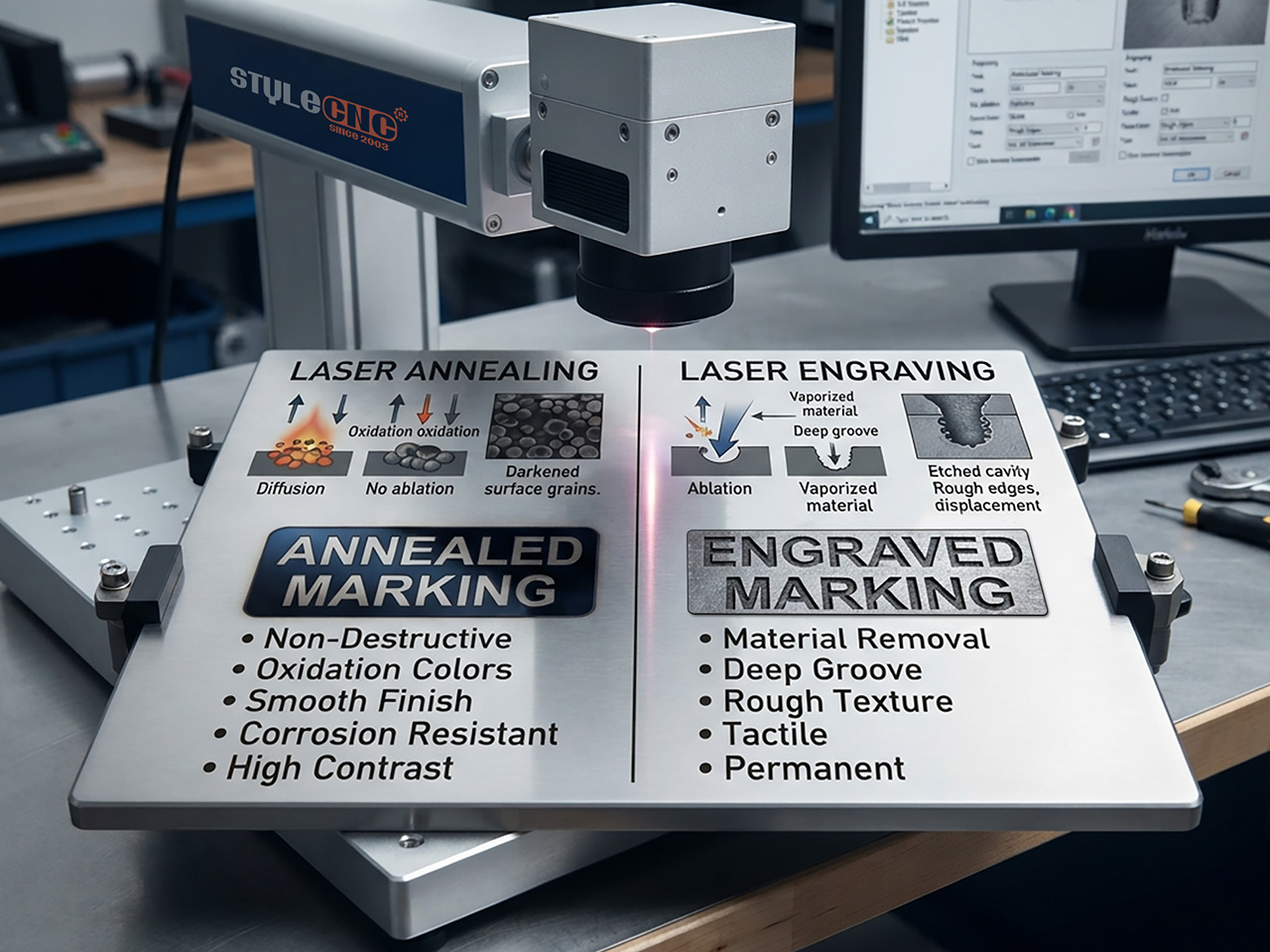
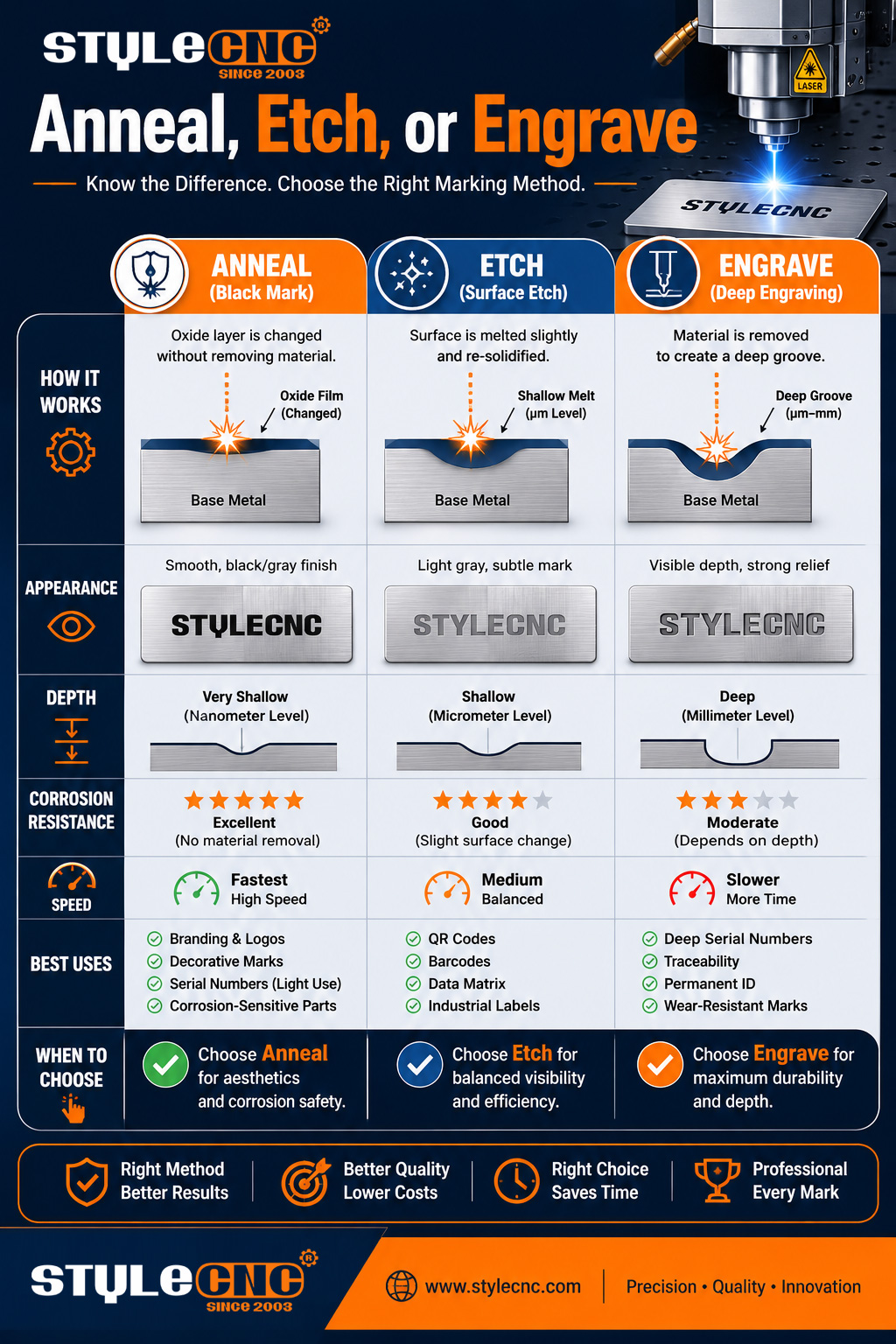
Annealing is pure heat. The beam warms the surface until a controlled oxide grows within it, changing color without removing a single micron, so the finish stays smooth.
Etching melts a whisper-thin layer that resolidifies with slight texture, trading a little surface change for real speed. Engraving goes further and excavates measurable depth, the only route to regulator-grade serials such as those the ATF specifies for firearms.
All 3 run on the same машыны для лазернай маркіроўкі hardware; only the recipe changes. That is why the comparison matters before the purchase, not after.
The Corrosion Question
Stainless resists rust because of a self-healing chromium oxide skin. Engraving cuts straight through that skin, and the fresh grooves corrode 1st in wet or salty service unless the part is re-passivated to standards such as those published by ASTM Міжнародны.
Annealing works with the skin instead of against it. The grown oxide is continuous with the protective layer, which is why the marks survive autoclaves, detergents, and outdoor exposure unchanged.
That single property drives the medical and food sectors toward annealed identifiers, including the device codes tracked under FDA medical device rules.
Annealing vs Etching vs Engraving at a Glance
| атрыбут | адпал | Гравіраванне | Гравюра |
| Вымярэнне | Oxide film, tens of nanometers | Melt layer, under 25 microns | Removed depth, 10 to 500 microns |
| Surface after marking | Smooth, texture unchanged | Slight raised texture | Recessed grooves and ridges |
| Passive chromium layer | захавалася | Mostly preserved | Removed inside the mark |
| Каразійныя паводзіны | Unchanged from base metal | Near original | Needs re-passivation for wet service |
| Адносная хуткасць | Самы павольны | Самы хуткі | Slow, multiplies with depth |
| Тыповыя віды выкарыстання | Medical tools, food gear, decorative black | Logos, codes, volume ID | Serials, molds, abrasive service |
Speed comparisons assume identical artwork on the same 30W fiber source. Etch texture varies with frequency and can approach anneal smoothness at high settings.
Practical Fiber Settings for Each Mark
The windows below suit a 30W fiber source on 304 plate and turn the theory into first-run numbers. Валаконна-лазерныя маркіровачныя машыны across this power class behave similarly once focus is dialed.
| Target Result | Хуткасць | магутнасць | Fréquence | Фокус | пропуску |
| Вымярэнне | мм / с | percent of rated output | кГц | offset from sharp focus | лічыць |
| Dark anneal | 100-250 | 50-70 | 40-60 | Plus 1 to 3 mm | 1 |
| Contrast etch | 500-800 | 35-50 | 30-50 | востры | 1 |
| Глыбокая гравіроўка | 400-600 | 80-100 | 20-30 | Sharp, stepped down per layer | 10-40 |
Values assume mirror or matte 304. Bead-blasted, brushed, and 316 surfaces shift every window, so ramp-test each finish before production.
Defocus is the annealing lever most spec sheets skip. Lifting the head 1 to 3 mm above sharp focus spreads the spot, drops intensity below the ablation threshold, and lets heat soak in; pulse control, the Розніца паміж крыніцамі MOPA і Q-пераключальнікам, decides how gently each pulse lands.
Depth work flips every priority: sharp focus, maximum power, low frequency, and patience. Dedicated platforms such as the 50W fiber deep engraving machine for metal step the focal plane down as the cavity grows.
Ключавыя лічбы, якія варта запомніць
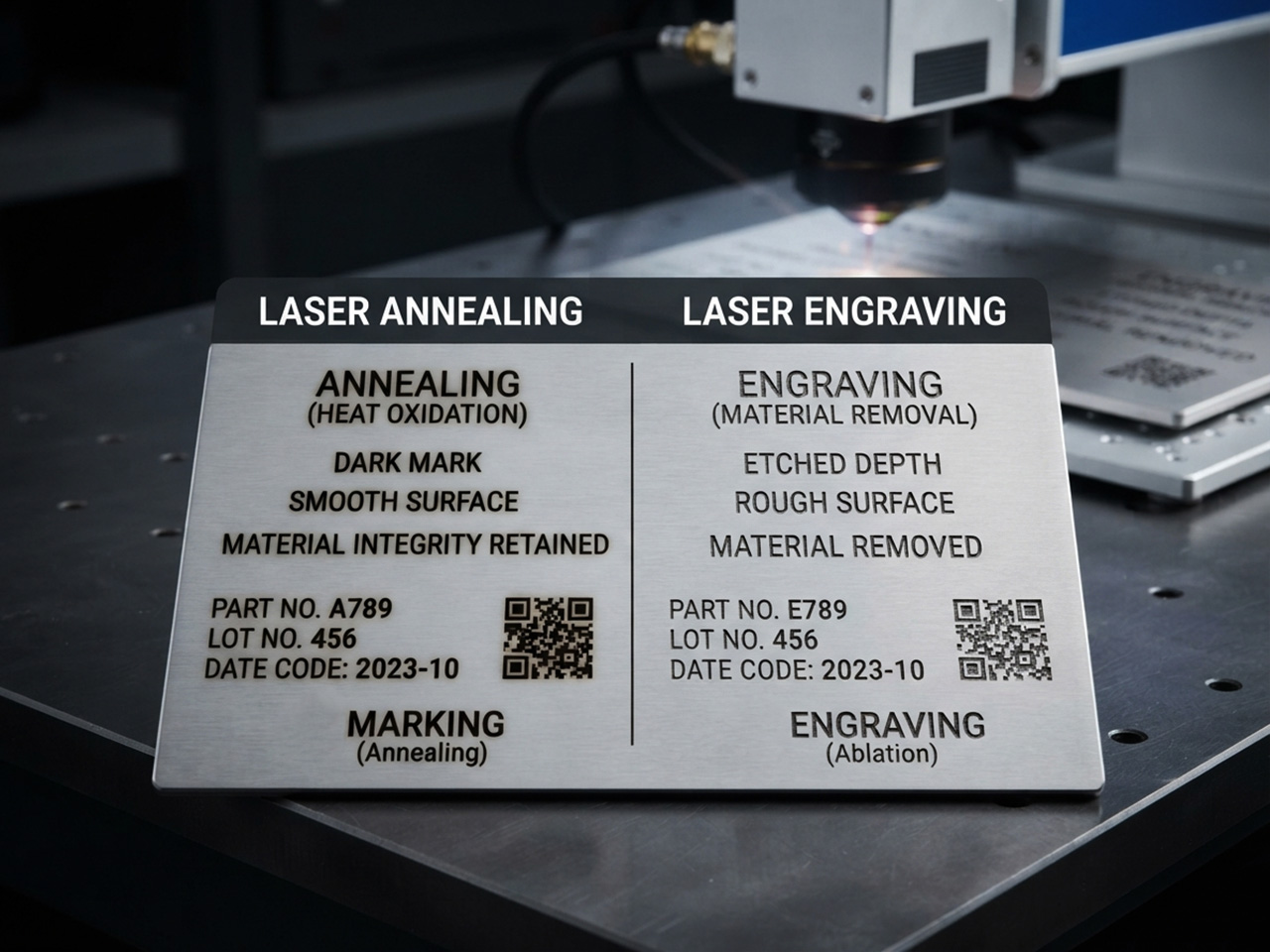
• Anneal oxide films measure tens of nanometers; engraving removes anywhere from 10 to 500 microns.
• A defocus of 1 to 3 mm is enough to move most 20W у 50W sources from ablation into pure heating.
• Etching typically finishes the same artwork several times faster than annealing.
• Deep engraving stacks 10 to 40 passes, so budget minutes where an etch takes seconds.
• Annealed data matrix codes stay readable through hundreds of autoclave cycles, the reason hospitals specify them.
• STYLECNC's gallery of marking results on steel shows annealed, etched, and engraved samples side by side.
Пытанні, якія аператары сапраўды задаюць
Which process should I quote for surgical clamps?
Annealing, almost without exception. The mark survives autoclave cycles, leaves no crevice for contamination, and keeps the identifier readable for the working life of the instrument.
Why does depth take so much longer than contrast?
Engraving lifts only a few microns of metal per pass, so a 0.2 mm serial can stack dozens of passes. Contrast is a thermal pass; depth is excavation.
Can one machine really do all 3 marks?
Yes. A single fiber source switches between anneal, etch, and engrave purely by recipe, and with a MOPA color source the same platform reaches gold and blue as well.
Common Mistakes That Blur the Line
• Calling any black mark an anneal; surface texture is the tell.
• Annealing at sharp focus and quietly ablating instead.
• Skipping the defocus ramp test after a lens or source change.
• Engraving stainless and shipping it to wet service without re-passivation.
• Reusing mirror-plate recipes on brushed or bead-blasted finishes.
• Expecting an anneal to survive grinding or heavy abrasion.
• Running one frequency for anneal, etch, and engrave alike.
• Marking before welding or bending instead of after.
Process Selection Checklist
✓ Confirm the requirement first: contrast only, or measurable depth.
✓ Verify the alloy; annealing wants ferrous or titanium surfaces.
✓ Run a defocus ramp from sharp focus to plus 3 mm on scrap.
✓ Time both processes on real artwork before quoting volume.
✓ Keep anneal jobs to slow single passes; resist stacking heat.
✓ Re-passivate any engraved stainless bound for wet service.
✓ Log recipe, focus offset, and surface finish with every job.
Questions fréquemment posées
Why does my black mark rust after a few weeks?
Because it was probably an etch or a light engrave, not an anneal. Run a fingernail across it: any texture means material left the surface and the passive layer went with it. A true anneal feels identical to the surrounding steel and weathers the same.
How much defocus does annealing need?
Start 1 mm above sharp focus and step upward in 0.5 mm increments to about 3 mm. More offset spreads the energy and slows oxide growth; too much and the mark fades to grey. A ramp test on scrap finds the sweet spot in minutes.
можа CO2 laser anneal stainless?
No. Bare metal reflects the long CO2 wavelength, so the surface never absorbs enough heat to grow the oxide. CO2 machines mark stainless only through a bonding compound sprayed on first. Annealing belongs to fiber sources at 1064 nm.
Do annealed marks survive autoclaves and dishwashers?
Yes. The mark is an oxide grown into the surface rather than a coating on top, so repeated steam cycles, detergents, and disinfectants leave it untouched. That durability, plus the crevice-free finish, is exactly why medical device identifiers rely on the process.
Why did my anneal come out grey instead of black?
Grey means the oxide stopped short. Slow the speed 20 percent, tighten the defocus one step, or raise power slightly, changing one variable per run. Brushed and bead-blasted finishes also read lighter than mirror plate at identical numbers, so judge on the real finish.
Does annealing warp or weaken the part?
The heated zone is shallow and localized, so structural change on normal gauges is negligible. Thin foils are the exception: enough heat can tint the reverse side or introduce slight bow. On anything below 0.5 mm, drop power and add speed before committing.
Which process suits barcodes and data matrix codes?
Annealing, in most cases. The smooth dark field scans cleanly, hides no bacteria, and never fills with debris. High-volume lines sometimes accept etched codes for speed, but anywhere hygiene or long service life matters, the annealed version wins the readability contest over time.
How deep must a regulated serial number be?
Depth rules are industry and jurisdiction specific, and surface annealing cannot satisfy any of them. Firearm serials in the United States, for example, must be engraved to a set minimum depth, which is why deep engraving remains mandatory in that category.
Can annealing make colors instead of black?
Yes, when the source allows pulse-width control. Adjustable pulses grow the oxide to different thicknesses, and each thickness reflects a different hue, from gold through purple to blue. Fixed-pulse sources mostly land black or straw tones no matter the recipe.